
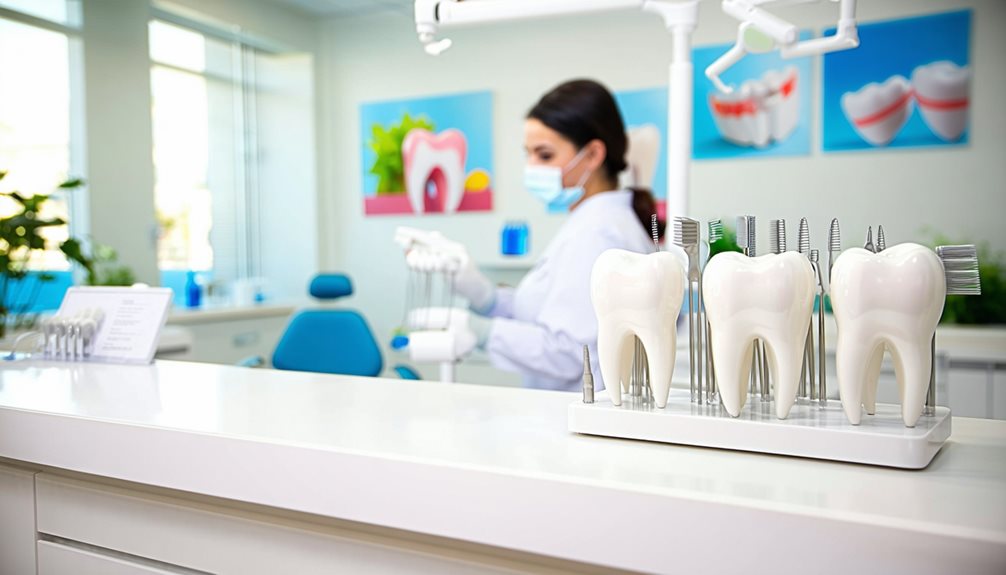
Preventing dental decay requires a multifaceted approach. Regular dental checkups facilitate early detection and intervention, reducing the incidence of severe oral diseases. Proper brushing with soft bristles and flossing daily disrupts plaque biofilms, protecting interdental areas from decay. An evidence-based diet, rich in calcium, phosphorus, and vitamin D, supports tooth remineralization and gum health. Fluoride treatments enhance enamel resistance, while sealants provide a durable barrier against cariogenic bacteria. These actions are supported by research as effective in maintaining oral health. Explore further to uncover the latest advancements in preventive care and personalized strategies for decay prevention.
Regular Dental Checkups
Regular dental checkups, serving as a cornerstone of preventive dental care, are vital for maintaining ideal oral health. The importance of prevention cannot be overstated, as it allows for the early detection and management of oral diseases, mitigating the risk of progression to more severe conditions.
Dental professionals utilize thorough examinations to identify early signs of caries, periodontal disease, and other oral pathologies, employing advanced diagnostic tools and techniques that have become increasingly sophisticated through innovation.
Scheduling appointments at regular intervals, typically biannually, is a strategic measure to guarantee continuous monitoring of oral health status. This regularity allows for timely interventions and reinforces patient adherence to preventive regimens.
Evidence-based practice supports the notion that systematic appointments contribute considerably to the reduction of dental decay incidence and the maintenance of periodontal health.
In the context of an ever-evolving dental landscape, patient education during these checkups is paramount. Patients are empowered with knowledge regarding the latest preventive strategies and oral hygiene innovations, reinforcing the collaborative nature of modern dental care.
Proper Brushing Techniques
In the domain of preventive dentistry, while professional dental checkups play a notable role in maintaining oral health, the foundation of daily oral hygiene practices begins with proper brushing techniques. This foundational practice is underpinned by two critical components: brushing frequency and toothbrush selection.
Contemporary evidence suggests that brushing twice daily, preferably postprandially, remains the gold standard. This frequency is essential for the disruption of dental plaque biofilms, which are precursors to carious lesions.
Toothbrush selection is equally pivotal. Innovations in toothbrush design, such as oscillating-rotating electric models, have demonstrated superior efficacy in plaque removal compared to manual counterparts. The American Dental Association recommends choosing toothbrushes with soft, rounded bristles to minimize enamel abrasion and gingival trauma.
Additionally, the advent of smart toothbrushes, equipped with sensors and AI-driven feedback, presents a novel approach to enhance user technique and compliance.
Adopting a meticulous brushing technique involves angling the toothbrush at 45 degrees towards the gingival margin, employing gentle, circular motions to effectively cleanse both the gingival sulcus and tooth surfaces.
To summarize, integrating ideal brushing frequency with technologically advanced toothbrush selection can greatly mitigate the risk of dental decay, aligning with contemporary preventive care paradigms.
Flossing Daily
Daily flossing, as an integral component of oral hygiene, targets interdental areas where toothbrush bristles cannot reach. This practice is essential for disrupting and removing biofilm, which accumulates between teeth, greatly reducing the risk of gingivitis and periodontal disease.
Emerging flossing techniques, such as the use of water flossers and interdental brushes, have been shown to enhance the removal of plaque, particularly in individuals with orthodontic appliances or dental implants. These innovative methods provide an alternative to traditional string floss, offering increased accessibility and comfort, thereby improving compliance rates among users.
The flossing benefits are substantial, with clinical studies affirming its efficacy in reducing interproximal caries by up to 40%. The mechanical action of flossing not only dislodges food particles but also prevents the formation of tartar, thereby inhibiting the progression of dental caries.
Furthermore, regular interdental cleaning has been linked to a decrease in systemic inflammation, suggesting a positive impact on overall health, including cardiovascular well-being.
Balanced Diet Choices
A balanced diet plays a critical role in maintaining oral health by providing essential nutrients that support the structural integrity and function of teeth and gums. Nutrient-rich foods such as dairy products, leafy greens, and lean proteins contribute greatly to the oral ecosystem by supplying calcium, phosphorus, and vitamin D, which fortify enamel and enhance remineralization processes.
Adequate intake of vitamin C from fruits like oranges and strawberries is paramount for gum health, as it aids in collagen synthesis, reinforcing the periodontal ligament.
Incorporating sugar substitutes like xylitol and stevia can be a strategic component of dietary modification. These sugar alcohols not only provide the sweetness of traditional sugars without the cariogenic potential but also actively inhibit the adherence of Streptococcus mutans to dental surfaces, thereby reducing the risk of plaque formation and subsequent decay.
Emerging evidence suggests that xylitol may enhance salivary flow, further promoting oral clearance and the neutralization of acidic environments.
To optimize oral health outcomes, it is imperative for individuals to integrate diverse nutrient-rich foods while moderating exposure to fermentable carbohydrates. This dietary innovation supports a holistic approach to preventing dental decay, incorporating both protective nutrients and innovative substitutes for sugar.
Fluoride Treatments
Fluoride remains a cornerstone in the prevention of dental caries due to its robust efficacy in enhancing enamel resistance and facilitating the remineralization of demineralized areas.
As a preventative agent, fluoride applications are integral in both pediatric and adult dentistry, offering substantial fluoride benefits through various modalities. Topical fluoride treatments, including gels, varnishes, and foams, deliver high concentrations directly to the tooth surface, optimizing the protective barrier against acidogenic bacterial activity.
Clinical studies underscore the effectiveness of professionally applied fluoride, demonstrating a significant reduction in caries incidence. By incorporating fluoride into the hydroxyapatite matrix of enamel, these applications enhance structural integrity, making teeth less susceptible to demineralization.
Furthermore, fluoride promotes the remineralization of early carious lesions, effectively reversing the initial stages of decay and precluding the necessity for more invasive interventions.
Innovative delivery systems, such as slow-release fluoride devices and bioactive glass, are emerging, promising sustained fluoride release and enhanced patient compliance.
These advancements align with the growing emphasis on personalized dental care, ensuring that fluoride treatments are tailored to individual caries risk profiles.
Hence, fluoride applications continue to evolve, offering critical benefits in caries prevention and oral health maintenance.
Dental Sealants
Dental sealants are a highly effective preventive measure designed to protect occlusal surfaces from caries by creating a physical barrier against plaque accumulation.
The application process involves the meticulous cleaning and etching of the tooth surface, followed by the precise placement and curing of the sealant material, ensuring optimal adherence and longevity.
Ideal candidates for sealants typically include children and adolescents with deep pits and fissures, yet adults with high caries risk may also benefit from this intervention.
Benefits of Dental Sealants
Preventive dentistry underscores the importance of dental sealants as a formidable barrier against tooth decay. These thin, protective coatings, typically composed of advanced sealant materials such as bisphenol A-glycidyl methacrylate (Bis-GMA) or urethane dimethacrylate (UDMA), are meticulously applied to the occlusal surfaces of molars and premolars.
Empirical evidence suggests that sealants effectively reduce caries incidence by approximately 80% in posterior teeth, providing a cost-effective and efficient adjunct to oral hygiene practices.
The benefits of dental sealants extend beyond mere physical barriers. Their application duration is remarkably expedient, often requiring less than 10 minutes per tooth. This swift procedure guarantees minimal discomfort and disruption for patients, promoting widespread adoption in pediatric and adult populations.
Additionally, sealants offer long-term protection; studies indicate their efficacy can span several years, contingent upon regular dental evaluations and maintenance.
Innovations in sealant materials have enhanced their biocompatibility and retention rates, with contemporary formulations exhibiting improved adhesion and resistance to masticatory forces.
This progress highlights the critical role dental sealants play in modern preventive strategies, aligning with a forward-thinking approach to oral health by greatly mitigating the risk of dental caries in susceptible populations.
Application Process Steps
The application process of dental sealants is a meticulous procedure that guarantees ideal adhesion and longevity of the protective barrier. This method involves a series of precise application techniques, ensuring the sealant’s effective function as a preventive measure against caries.
Initially, the tooth surface must undergo thorough cleaning to eliminate debris and plaque, typically achieved using a prophylaxis brush and pumice. Following this, the tooth is isolated with cotton rolls or dental dams to prevent moisture interference.
An etching agent, usually a phosphoric acid solution, is applied to the occlusal surfaces to create micro-retentions necessary for optimal bonding. After rinsing and drying the tooth completely, the sealant material is methodically applied. The choice of sealant—resin-based or glass ionomer—depends on specific clinical scenarios and the dentist’s discretion.
Curing is performed using a high-intensity light source to polymerize the resin-based sealant, enhancing its durability and adhesion.
Post-application inspection is essential, employing tactile exploration and visual examination to verify the sealant’s integrity and coverage. This evidence-based process not only exemplifies cutting-edge application techniques but also reinforces the importance of dental sealants as a proactive component of preventive measures in oral healthcare.
Ideal Candidates for Sealants
Sealants serve as a crucial protective measure for individuals at heightened risk of dental caries, mainly targeting specific demographics. Pediatric patients are considered primary candidates for sealant application due to the distinct morphological characteristics of their molars, which present deep pits and fissures susceptible to bacterial colonization.
Evidence-based research underscores that applying sealants to the permanent molars of children markedly reduces the incidence of cavities, effectively providing a physical barrier against cariogenic bacteria and fermentable carbohydrates.
High cavity risk patients, encompassing not only pediatric patients but also adolescents and adults with a history of frequent caries, benefit greatly from sealant application. This intervention is particularly advantageous for individuals with compromised salivary flow or dietary patterns that predispose them to carious lesions.
Advanced dental sealant technology, incorporating antimicrobial agents and fluoride release in some formulations, offers innovative solutions tailored to these high-risk groups, enhancing the preventive efficacy of traditional sealants.
Moreover, sealants are recommended for patients with orthodontic appliances, as these devices create additional plaque retention zones.
Utilizing sealants as part of a thorough caries management strategy emphasizes a proactive approach, aligning with contemporary preventive dentistry paradigms and fostering long-term oral health.
Frequently Asked Questions
Can Stress Contribute to Tooth Decay?
Stress can indirectly contribute to tooth decay by affecting oral hygiene practices negatively. Implementing effective stress management techniques can enhance oral health by promoting regular brushing and flossing, thereby mitigating decay risks through improved dental care adherence.
How Does Saliva Help in Preventing Cavities?
Saliva functions as a critical defense mechanism in cavity prevention by neutralizing acids, providing essential minerals for remineralization, and facilitating the clearance of food particles, thereby maintaining oral pH balance and reducing bacterial colonization on dental surfaces.
Are There Any Natural Remedies Effective Against Tooth Decay?
Considering the current question, natural remedies utilizing natural ingredients and herbal treatments, such as green tea polyphenols and clove oil, demonstrate potential efficacy against tooth decay. However, further clinical trials are necessary to substantiate their effectiveness and innovate dental care practices.
What Role Do Genetics Play in Dental Health?
Genetic predisposition and hereditary factors greatly influence dental health by affecting enamel strength, saliva composition, and susceptibility to periodontal disease. Understanding these genetic components can lead to innovative, personalized approaches in preventive dentistry and treatment strategies.
Can Chewing Gum Prevent Tooth Decay?
Chewing sugar-free gum can confer notable dental benefits by stimulating saliva production, which neutralizes acids and aids in remineralization processes. Clinical studies indicate its role in reducing caries risk, thereby supporting innovative, preventive dental health strategies.
Conclusion
To summarize, the prevention of dental decay is ideally achieved through a multifaceted approach encompassing regular dental checkups, adherence to proper brushing techniques, and consistent daily flossing. Additionally, the incorporation of a balanced diet, accompanied by appropriate fluoride treatments and the application of dental sealants, further mitigates the risk of decay. Collectively, these evidence-based practices form an all-encompassing strategy that promotes oral health and reduces the incidence of carious lesions, thereby enhancing overall dental well-being.

